The hardest problem I've attempted
Setup
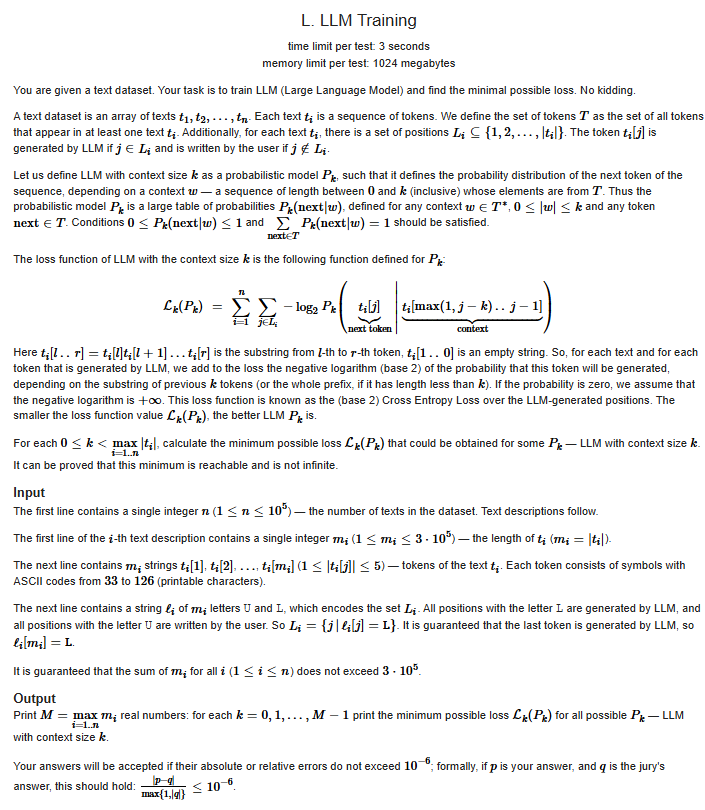
Dataset: texts . Each text marks some positions as LLM-generated (set ). For each from to where , find the minimum cross-entropy loss
over every valid context- probabilistic model . Constraints: .
The model is a lookup table
There is no training. is a free distribution per context , so we minimize each context independently. For context with next-token counts summing to , minimize
Gibbs gives with optimum value . So
summed over distinct length- contexts that precede an L-position. The problem reduces to: for every , group L-positions by their length- context, fast.
Trie blows up
A trie of reversed prefixes ending at L-positions has up to nodes when one text is tokens long. Dead.
Generalized suffix automaton
Build a generalized SAM over all texts (integer alphabet, map<int,int> per state). It has states. For each L-position identify the state representing the full prefix .
In the SAM’s suffix-link tree, state holds strings of lengths . The length- context of for is a suffix of its prefix, and that suffix lives in the unique ancestor of whose length range covers .
For a fixed state with , :
- : every L-position in ‘s suffix-link subtree lands at . Contribute the entropy of all their next-tokens.
- : only L-positions whose stay (descendants moved deeper). Contribute the entropy over just those.
Both are interval updates on the answer array. Difference array, prefix-sum at the end.
Subtree entropies via small-to-large
For each state we need where . Walk the suffix-link tree post-order, merging child next-token count maps small-to-large into the parent. Maintain incrementally: when count of changes from to , add .
Each token participates in merges, total .
Full code
Click to expand (~340 lines)
// CF 2181L - LLM Training
// the trick: the optimal model is just the empirical distribution
// (gibbs inequality). once you see that, the "training" goes away and
// what's left is: group every L-position by its length-k context and
// compute entropy of next-tokens per group.
//
// naive is O(N*M). need to share work across k.
//
// build a generalized suffix automaton over all texts. each L-position
// at (i,j) sits at some SAM state s* (the state for prefix t_i[1..j-1]).
// for context length k:
//   - it lives at s* if minlen(s*) <= k
//   - otherwise it lives at some ancestor of s* in the suffix-link tree
//
// so each SAM state s contributes to ans[k]:
//   - for k in [minlen(s), maxlen(s)]: entropy over ALL L-positions in
//     its suffix-link subtree
//   - for k > maxlen(s): entropy over only L-positions whose s* == s
//     (everyone else has moved on to deeper states)
//
// both are range updates -> difference array.
//
// subtree entropies are aggregated via small-to-large on the suffix-link
// tree, maintaining sum_x f(c(x)) incrementally so we never recompute.
//
// precision: doubles are fine, problem allows 1e-6.

#include <bits/stdc++.h>
using namespace std;

// f(c) = c*log2(c), with f(0)=0. precomputed because we call it a LOT
// during the small-to-large merge and log() isn't cheap.
static vector<double> Fcache;
static inline double f_of(long long c) {
    if (c <= 0) return 0.0;
    if ((size_t)c < Fcache.size()) return Fcache[(size_t)c];
    return (double)c * log2((double)c);
}

// generalized SAM. tokens are ints (huge alphabet) so map<int,int> per
// state. between texts we just reset `last` to root; that's the whole
// "generalized" trick.
struct SAM {
    struct State {
        int len;
        int link;
        map<int, int> next;
    };
    vector<State> st;
    int last;

    void init() {
        st.clear();
        st.reserve(4);
        st.push_back({0, -1, {}});
        last = 0;
    }
    void reset_last() { last = 0; }

    int extend(int c) {
        // generalized-SAM gotcha: if `last` already has a transition on c,
        // the string we'd be adding has been seen before. don't make a
        // new state, just walk into the existing one (with a possible clone).
        if (st[last].next.count(c)) {
            int p = last;
            int q = st[p].next[c];
            if (st[p].len + 1 == st[q].len) {
                last = q;
                return q;
            }
            int clone = (int)st.size();
            st.push_back({st[p].len + 1, st[q].link, st[q].next});
            while (p != -1 && st[p].next.count(c) && st[p].next[c] == q) {
                st[p].next[c] = clone;
                p = st[p].link;
            }
            st[q].link = clone;
            last = clone;
            return clone;
        }
        int cur = (int)st.size();
        st.push_back({st[last].len + 1, -1, {}});
        int p = last;
        while (p != -1 && !st[p].next.count(c)) {
            st[p].next[c] = cur;
            p = st[p].link;
        }
        if (p == -1) {
            st[cur].link = 0;
        } else {
            int q = st[p].next[c];
            if (st[p].len + 1 == st[q].len) {
                st[cur].link = q;
            } else {
                int clone = (int)st.size();
                st.push_back({st[p].len + 1, st[q].link, st[q].next});
                while (p != -1 && st[p].next.count(c) && st[p].next[c] == q) {
                    st[p].next[c] = clone;
                    p = st[p].link;
                }
                st[q].link = clone;
                st[cur].link = clone;
            }
        }
        last = cur;
        return cur;
    }

    int size() const { return (int)st.size(); }
    int len(int s) const { return st[s].len; }
    int link(int s) const { return st[s].link; }
    int minlen(int s) const { return s == 0 ? 0 : st[st[s].link].len + 1; }
};

int main() {
    ios::sync_with_stdio(false);
    cin.tie(nullptr);

    int n;
    if (!(cin >> n)) return 0;

    unordered_map<string, int> tokId;
    tokId.reserve(1 << 16);

    vector<vector<int>> texts(n);
    vector<string> isLLM(n);

    int totalTokens = 0;
    int M = 0;

    for (int i = 0; i < n; ++i) {
        int m;
        cin >> m;
        texts[i].resize(m);
        for (int j = 0; j < m; ++j) {
            string s;
            cin >> s;
            auto it = tokId.find(s);
            int id;
            if (it == tokId.end()) {
                id = (int)tokId.size();
                tokId.emplace(std::move(s), id);
            } else {
                id = it->second;
            }
            texts[i][j] = id;
        }
        cin >> isLLM[i];
        totalTokens += m;
        M = max(M, m);
    }

    Fcache.assign(totalTokens + 1, 0.0);
    for (int c = 1; c <= totalTokens; ++c) {
        Fcache[c] = (double)c * log2((double)c);
    }

    // build the SAM, and as we go, remember which state we're at after
    // each prefix of each text. state_after[i][p] = state for t_i[1..p].
    SAM sam;
    sam.init();

    vector<vector<int>> state_after(n);
    for (int i = 0; i < n; ++i) {
        sam.reset_last();
        int m = (int)texts[i].size();
        state_after[i].resize(m + 1);
        state_after[i][0] = 0;
        for (int p = 0; p < m; ++p) {
            int s = sam.extend(texts[i][p]);
            state_after[i][p + 1] = s;
        }
    }
    int S = sam.size();

    // for each L-position (i, j), bucket the next-token (= t_i[j]) under
    // its full-prefix state s*. these are the positions that "live" at s*
    // permanently once k passes maxlen(s*).
    vector<vector<int>> own(S);
    for (int i = 0; i < n; ++i) {
        int m = (int)texts[i].size();
        for (int j = 1; j <= m; ++j) {
            if (isLLM[i][j - 1] == 'L') {
                int s = state_after[i][j - 1];
                own[s].push_back(texts[i][j - 1]);
            }
        }
    }

    // E_own(s) = entropy of own[s]'s next-token distribution
    //          = f(C) - sum_x f(c(x))
    vector<double> E_own(S, 0.0);
    for (int s = 0; s < S; ++s) {
        if (own[s].empty()) continue;
        unordered_map<int, int> cnt;
        cnt.reserve(own[s].size() * 2);
        for (int x : own[s]) cnt[x]++;
        long long C = (long long)own[s].size();
        double sumf = 0.0;
        for (auto &kv : cnt) sumf += f_of(kv.second);
        E_own[s] = f_of(C) - sumf;
        if (E_own[s] < 0) E_own[s] = 0;
    }

    vector<vector<int>> children(S);
    for (int s = 1; s < S; ++s) {
        children[sam.link(s)].push_back(s);
    }

    // post-order walk of the suffix-link tree, merging children into parents
    // small-to-large. for each state we keep:
    //   - map: next-token -> count in subtree
    //   - sumF: sum_x f(count(x))
    //   - totC: sum of counts
    // then E_sub(s) = f(totC) - sumF.
    vector<unordered_map<int, int>*> sub(S, nullptr);
    vector<double> sumF(S, 0.0);
    vector<long long> totC(S, 0);
    vector<double> E_sub(S, 0.0);

    vector<int> order;
    order.reserve(S);
    {
        vector<int> stk;
        stk.reserve(S);
        stk.push_back(0);
        while (!stk.empty()) {
            int u = stk.back(); stk.pop_back();
            order.push_back(u);
            for (int v : children[u]) stk.push_back(v);
        }
    }
    for (int idx = (int)order.size() - 1; idx >= 0; --idx) {
        int s = order[idx];
        unordered_map<int,int>* mp = new unordered_map<int,int>();
        double sf = 0.0;
        long long tc = 0;
        if (!own[s].empty()) {
            mp->reserve(own[s].size() * 2);
            for (int x : own[s]) {
                auto it = mp->find(x);
                if (it == mp->end()) {
                    (*mp)[x] = 1;
                    sf += f_of(1);
                    tc += 1;
                } else {
                    int old = it->second;
                    it->second = old + 1;
                    sf += f_of(old + 1) - f_of(old);
                    tc += 1;
                }
            }
        }
        for (int c : children[s]) {
            unordered_map<int,int>* cmp = sub[c];
            if (!cmp) continue;
            if (cmp->size() > mp->size()) {
                swap(mp, cmp);
                swap(sf, sumF[c]);
                swap(tc, totC[c]);
            }
            for (auto &kv : *cmp) {
                int x = kv.first;
                int add = kv.second;
                auto it = mp->find(x);
                if (it == mp->end()) {
                    (*mp)[x] = add;
                    sf += f_of(add);
                } else {
                    int old = it->second;
                    int neu = old + add;
                    it->second = neu;
                    sf += f_of(neu) - f_of(old);
                }
            }
            tc += totC[c];
            delete cmp;
            sub[c] = nullptr;
        }
        sub[s] = mp;
        sumF[s] = sf;
        totC[s] = tc;
        double e = f_of(tc) - sf;
        if (e < 0) e = 0;
        E_sub[s] = e;
    }
    if (sub[0]) { delete sub[0]; sub[0] = nullptr; }

    // for each state s, with minlen=a, maxlen=b:
    //   E_sub(s) hits ans[k] for k in [a, b]
    //   E_own(s) hits ans[k] for k in [b+1, M-1]
    vector<double> diff(M + 1, 0.0);
    for (int s = 0; s < S; ++s) {
        int lo = sam.minlen(s);
        int hi = sam.len(s);
        if (lo > M - 1) continue;
        if (hi > M - 1) hi = M - 1;
        if (E_sub[s] != 0.0) {
            diff[lo] += E_sub[s];
            diff[hi + 1] -= E_sub[s];
        }
        int olo = sam.len(s) + 1;
        int ohi = M - 1;
        if (E_own[s] != 0.0 && olo <= ohi) {
            diff[olo] += E_own[s];
            diff[ohi + 1] -= E_own[s];
        }
    }

    cout.setf(std::ios::fixed);
    cout << setprecision(12);
    double run = 0.0;
    for (int k = 0; k < M; ++k) {
        run += diff[k];
        double out = run < 0 ? 0.0 : run;
        cout << out << "\n";
    }

    return 0;
}
Complexity
time, space in SAM states. Worst case (, single text, binary alphabet) runs in about 1 second; memory peak around 150 MB.
Why this problem is interesting
The framing is a magic trick. It opens with “train an LLM and find the minimum loss” and looks like an ML problem. There is no training. is a free lookup table, so the minimum is the closed-form Gibbs distribution and the entire optimization vanishes in one line. What you are left with is a string-algorithm problem wearing an ML costume.
The other thing I like is that the right solution sits at the intersection of three completely different ideas:
- Information theory (cross-entropy minimum is the empirical distribution).
- Suffix automata (the trie collapses into states because most contexts are equivalent).
- Small-to-large merging on the suffix-link tree (so we never rebuild a count map from scratch).
None of them alone solve it. You need to recognize that the problem is asking for entropies of context-grouped tokens, then realize that “context” is just “substring ending at position ”, which is exactly what a SAM enumerates compactly.
Thought process
What I actually did, in order:
- Stared at the loss formula. Spent a while just unpacking and convincing myself the was only there to handle the start of the text.
- Tried to picture “training” . Got nowhere until I noticed is a totally free distribution per context. At that point the problem stops being optimization and becomes: pick the best distribution per context independently. Gibbs gives the empirical distribution.
- Sanity-checked : all L-positions share the empty context, so , which is just times the empirical entropy. Matched the first sample.
- Wrote out a brute force: for each , group L-positions by their length- context, sum entropies. . Way too slow.
- Tried a trie of reversed prefixes. Looked clean for about five minutes until I worked out the worst case (one long text) and got nodes.
- Reached for SAM. The substrings ending just before each L-position are exactly what a generalized SAM enumerates. Took a while to nail down which SAM state holds which positions for which .
- Once I had “state contributes on and above”, the rest was bookkeeping: difference array for the range updates, small-to-large on the suffix-link tree to aggregate the next-token counts.
- Spent the longest debugging floating-point: can dip slightly below zero from rounding, and a negative entropy crashed my checker. Clamped at zero.
The big lesson for me: when a problem hands you an optimization over a free function space, check if the optimum has a closed form before doing anything else. If it does, the problem is no longer the problem you thought it was.